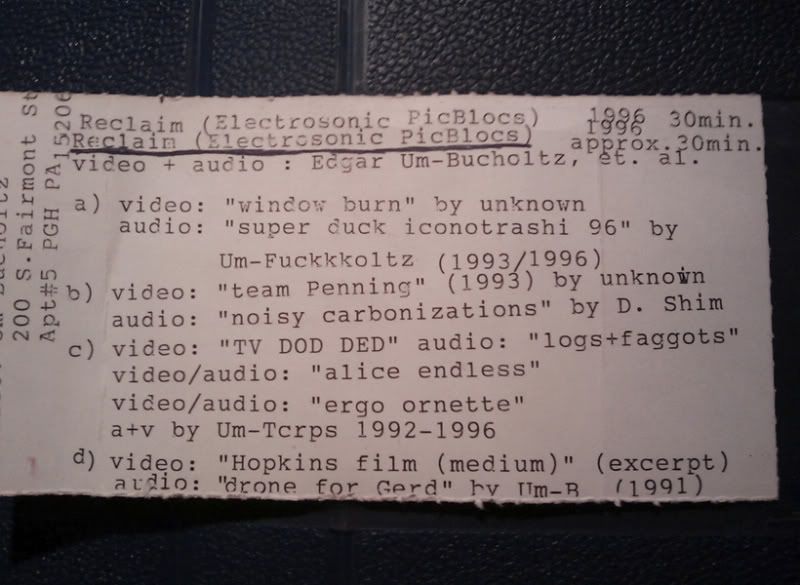
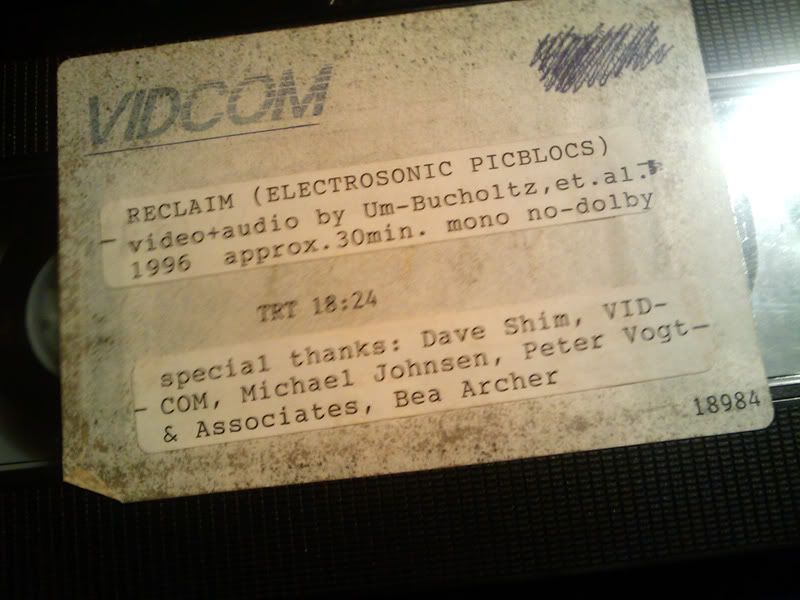
i stumbled upon this online. Csaba Toth is an old friend. he has been writing and lecturing about noise music (including noise music from Pittsburgh) since the early 1990s.
this is a recent essay from "Noise & Capitalism", a collection of essays chosen by editors, Mattin & Anthony Iles.
i include it here because he mentions Telecorps, Fuck Telecorps and Macronympha.

Title: Noise and Capitalism
Publisher: Arteleku Audiolab (Kritika series), Donostia-San Sebastián (Gipuzkoa), Spain
Publication date: September 2009
ISBN: 978-84-7908-622-1
Contributors: Ray Brassier, Emma Hedditch, Matthew Hyland, Anthony Iles, Sara Kaaman, Mattin, Nina Power, Edwin Prévost, Bruce Russell, Matthieu Saladin, Howard Slater, Csaba Toth, Ben Watson
Editors: Mattin & Anthony Iles
"Csaba Toth received his PhD from the University of Minnesota, and is Professor and Chair of the History Department at Carlow University in Pittsburgh, Pennsylvania. Toth's scholarly interests include social movements, production of gender, girl cultures, politics of sound, urban history, and pedagogy. His writings have been published by The M.I.T. Press, St. Martin's Press, and the San Francisco Museum of Modern Art. He was a guest professor of American Studies in Japan (1998–2000), lectured in Australia, Lithuania, Ukraine, Georgia, and Sweden, and has been the recipient of several major grants and awards (Fulbright Senior Lecturer, NEH, Newberry, George Soros Foundation, DAAD, Wise-Susman Prize)."
-----------------------------------------------------------------
"Noise Theory"
by Csaba Toth
In the mid-1980’s, Noise music seemed to be everywhere crossing oceans and circulating in continents from Europe to North America to Asia (especially Japan) and Australia. Musicians of diverse background were generating their own variants of Noise performance. Groups such as Einstürzende Neubauten, SPK, and Throbbing Gristle drew larger and larger audiences to their live shows in old factories, and Psychic TV’s industrial messages were shared by fifteen thousand or so youths who joined their global ‘television network.’ Some twenty years later, the bombed-out factories of Providence, Rhode Island, the shift of New York’s ‘downtown scene’ to Brooklyn, appalling inequalities of the Detroit area, and growing social cleavages in Osaka and Tokyo, brought Noise back to the center of attention. Just the past week – it is early May, 2007 – the author of this essay saw four Noise shows in quick succession – the Locust on a Monday, Pittsburgh’s Macronympha and Fuck Telecorps (a re-formed version of Edgar Um Bucholtz’s Telecorps of 1992-93) on a Wednesday night; one day later, Providence pallbearers of Noise punk White Mice and Lightning Bolt who shared the same ticket, and then White Mice again. The idea that there is a coherent genre of music called ‘Noise’ was fashioned in the early 1990’s. My sense is that it became standard parlance because it is a vague enough category to encompass the often very different sonic strategies followed by a large body of musicians across the globe. I would argue that certain ways of composing, performing, recording, disseminating, and consuming sound can be considered to be forms of Noise music. The Noise sub-themes behind Christian Marclay and DJ Olive’s turntablism, DJ Spooky’s illbient ‘electroneiric otherspace,’ Masonna’s bodybased performance, Philip Samartzis’ live mix of specially prepared CDs combined with real time synthesis and abstraction, Wolf Eyes’ ‘wailing, tortured dungeon sound’ (Ben Sisario in SPIN), Scot Jenerik’s fire-fuelled display of noisy destruction, Oren Ambarchi’s guitar experimentations, and the classics in the genre’s history, Throbbing Gristle, SPK, Z’ev, and the Haters clearly illustrate this point. I wish to state that it is the entire socio-cultural and historical matrix within which Noise is chosen, combined, and listened to that defines the genre.
Noise iN the society of sileNce aNd spectacle
According to French cultural theorist Guy Debord’s powerful analysis, life in late capitalism presents itself as an immense accumulation of spectacles.[1] Everything that was once directly lived has moved into representation. The society of the spectacle eliminates dialogue; the organization of the monologue by political and economic organizations isolates and prevents direct, localized, non-repeatable communication. The society of the spectacle, Jacques Attali claims in his pioneering book Noise, is also the society of silence.[2] These considerations enable us to theorize the rise of Noise music as a form of cultural disturbance in the silent and silenced deindustrialized space of late capitalism. Therefore, I will construct the beginnings of Noise performance as an aesthetic production that challenged social and cultural institutions, collapsed genre boundaries, and had broader socio-political implications. Noise music in its most uncompromising form is different from other forms of resistance musics such as punk, New Wave, hardcore, or dark metal. In these musics, the voice, the logos as truth, has constituted the ideal point of a politicised voice by claiming to speak the truth of its audience’s situation. Noise has no such claims; it is a radical deconstruction of the status of artist, audience, and music.[3] It is ‘the grain of the voice’,[4] a refusal of representation, a refusal of identity. Noise, at the very least,
[1] Guy Debord, The Society of the Spectacle (New York: Zone Books, 1995). [2] Jacques Attali, Noise: The Political Economy of Music (Minneapolis: University of Minnesota Press, 1985). See also Csaba Toth, ‘The Work of Noise’ in Amitava Kumar (ed.), Poetics/Politics: Radical Aesthetics for the Classroom (New York: St. Martin’s Press, 1999) 201-218 and ‘Sonic Rim: Performing Noise around the Pacific,’ in Kathleen Ford and Philip Samartzis (eds.), Variable Resistance: Australian Sound Art, with compact disc, (San Francisco: San Francisco Museum of Modern Art, 2003), 14-23. [3] For an exploration of these questions in theory, see especially Chapter Three in Jeremy Gilbert and Ewan Pearson, Discographies: Dance Music, Culture and the Politics of Sound (London and New York: Routledge, 1999). [4] Roland, Barthes, ‘The Grain of the Voice, ‘ in Image – Music – Text (New York: Hill and Wang, 1977), 179-189.
disrupts both the performer and listener’s normal relations to the symbolic order by refusing to route musical pleasure through the symbolic order (symbolic relations are defined here as an aggregate of guilt, the law, achievement, authority figures). We can call this musical pleasure anti-teleological jouissance, achieved by self-negation, by a return to the imaginary or the pre-subjective (the stage that precedes ego differentiation) – which, in our context, is a sonorous space. As for its ‘musical’ parameters, Noise is conceived to be anti-teleological in the sense that it digresses from the reified desire for the telos-driven formula of tension and release that characterizes most western musics, and particularly tangible in rock and pop performance. Instead, Noise speaks to and through our imaginary register of auditory, visual, haptic perceptions, and fantasy creating a chaos of sensations and feelings. I also wish to stress the performativity of Noise. It is enough to allude here to Francisco Lopez’s blindfolding his listeners, Christof Migone’s ‘corporeal glitches’ (Will Montgomery in The Wire), Runzelstirn & Gurgelstock’s releasing an amplified turkey laden with contact microphones during a live show, the humorous head-dives by the Incapacitants’ ‘big man,’ Fumio Kousakai, and the fanciful masks, headgears, and ‘choreographed’ movements of Lightning Bolt, the Locust, and White Mice. Why performance? What is the value of performance to Noise practitioners? I construct performance as an aesthetic production that challenges cultural institutions and genres, and has broader social implications. As queer performance theorist Ann Cvetkovich suggests, performance inhabits different locations – both discursive and material: the nation, the stage, the body.[5] What version of late capitalism is contested in the rise of Noise-based musics? Noise performance, in our view, exercises a culturally coded and politically specific critique of late capitalism, and offers tools for
[5] Ann Cvetkovich, ‘Comments,’ at the Annual Meeting of the American Studies Association, Nashville, TN, November 1994. In author’s possession.
undoing its seemingly incontestable hegemony. To be sure, Noise performance operates in the shadow of recontainment by the very commodity structures it intends to challenge. But resistance to such commodification continues to occur, and what cultural critic Russel A. Potter says about hip-hop appears to be true also for Noise music: ‘the recognition that everything is or will soon be commodified has ... served as a spur, an incitement to productivity.’[6] Let it be enough to mention here the hundreds of recordings by Merzbow, Francisco Lopez, Muslimgauze, and, most recently, the endless stream of cassettes and CD-Rs released by Wolf Eyes. It is worth noting that Noise has become a transnational global cultural form capable of mobilizing diverse constituencies. I wish to give a measure of historical specificity to Noise music by claiming that the rise of Noise was coeval with deindustrialization in the USA, Western Europe, and parts of the Asia-Pacific region.
Noise aNd history
The birth of Noise culture can only be understood in the context of the collapse of the industrial city. Noise is a profoundly metropolitan genre (even in its ecological form) that first registered its presence amidst the ravaged urban-industrial landscape and reactionary cultural climate of the Thatcher and Reagan years, and, perhaps to a lesser degree, the Yasuhiro Nakasone period. Concomitant with deindustrialization in the West and Japan was a development that went hand in hand with a globalizing process: the emergence of a global information network and immense transnational corporations. Saturation with consumer goods and informational simultaneity wove a web far finer and smaller scale than anything imaginable in the classical industrial era.
[6] Russell A. Potter, Spectacular Vernaculars: Hip-Hop and the Politics of Postmodernism (Albany, NY.: State University of New York Press, 1995), 8.
Deindustrialization continued to hit the Fordist economies of late capitalist societies between the late 1960’s and mid-1990s. Although the roots of industrial collapse are complex, the demise came with the changes global restructuring wrought. Cities such as Manchester, Leeds, (parts of) London, the Rust Belt in the United States (Pittsburgh, Detroit, Cleveland), major heavy industry centers in Australia such as Whyalla and Elizabeth in South Australia, Newcastle and Wollongong in New South Wales, had been particularly adversely affected by retrenchment and capital flight, becoming ghost towns of late capitalism. With the collapse of traditional industries, venture capitalists heavily invested in the new wave of ‘cyber work,’ producing North Carolina’s Research Triangle, Silicon Valley in the San Francisco Bay Area, and the ‘model’ city of the 1990’s, Seattle. We have witnessed the increasing concentration of the functions of ‘information capitalism’ in central Tokyo. Australia began ‘to confront the realities of world markets’ (Paul Keating, Labor Prime Minister) by simultaneously deregulating its industries and advocating the mantra of cyber-work under the sugar-coated slogan of ‘Clever Country.’ In reality, the selling points with which these cities tried to lure back capital sounded like whimpers coming from a desperate ‘underdeveloped’ country: promises of lower wages, lower rents, tax abatement or tax breaks, and corporation-friendly local office holders. The economic ‘upswing’ cycle since the mid-1990’s has been, statistically, characterized by a dramatic rise in employment. What these statistics hide though is that most new jobs represent flexi-work, that is, partial employment with no benefits. While this economic ‘boom’ has produced harder times for the middle sectors, it solidified the stagnation or further submergence of the labour pool hit by earlier processes of deindustrialization. Also, perhaps crucially, it reinforced racial/ethnic bifurcation (Berlin, Budapest, Pittsburgh) and a multi-dimensional fissure of space, race, and class (Chicago, London, Paris, Sydney) in the post-Fordist city.[7] A new regime of representation set out to celebrate the ‘visible and audible rehabilitation’ of the city, and, in the process, shifted attention away from the arid row houses, impoverished ghettos, bleak projects, and the neubauten that had loomed so large in the 1980’s, early 1990’s. And while, as music scholar Adam Krims states, representationally, a new music-poetics marked the ‘re-conquest’ of the city,[8] forces of law and order imposed materially a brutal silence on the city’s subaltern subjects from New York to Paris as sky-rocketing rates of incarceration for petty crimes, anti-immigrant hysteria, and paramilitary presence in certain neighborhoods have shown. I will argue that Noise music, although not always unproblematically, intervened into this silenced space, and functioned as a resistant cultural form. Performers produced, found, and invented new Noise instruments, and applied guerilla tactics of street theater (Einstürzende Neubauten’s disassembling a part of the Autobahn, for instance). Their work was collective; what was played was not the work of a single creator – audiences initially barely knew the names of those behind most of these groups. Recordings were made on ‘production sites’ set up by industrial performers (see Throbbing Gristle’s Industrial Records; Manny Theiner’s SSS label in Pittsburgh; Load Records in Providence; etc.). Groups stayed together for a short time, and dissolved only to regroup for another intervention. To be a Noise performer meant a day-to-day and subversive activity, a guerilla tactic, a constant war of position.
[7] Janet L. Abu-Lughod, New York, Chicago, Los Angeles: America’s Global Cities (Minneapolis: University of Minnesota Press, 1999), 357. [8] Adam Krims, Music and Urban Geography (Routledge: New York, 2007), 123.
Noise Music as GeNre
Noise music, in its many alterations, ruptures conventional generic boundaries: it is often not music at all, but noise, or sound, combined with visual material (video, DVD, public-access cable television, radio, the internet). Due to its polymorphism, it escapes the closure of the (theatrical) stage. It is often performed and disseminated outside the commercial nexus (in fact, Noise music probably would not exist without the selfactivity of its fans). When staged, the relation between performer and everyday person is blurred, and participation by audience members in Noise events is, in specific instances, a distinctive phenomenon. At its inception, Noise music was informed by a diverse set of assumptions, cultural and political, in its approach to postindustrial society. In musical terms, Noise performers’ formative experience entailed a confrontation with what they perceived as the destruction of rock music by a culture industry reflective of mass production and what Attali calls repetition. Industrial standardization in the record industry in particular translated to them as the emergence of a single totalitarian code. The initial impetus behind Noise rested on the assumption that since industrial production sets the terms for repetition inside mass-produced music, any cultural form of repetition inside the commodity market would be subsumed by the overarching logic of industrialization. Therefore Noise musicians generated non-repeatable music outside of the commercial nexus.
Noise as eNjoyMeNt?
Noise is pre-linguistic and pre-subjective. The noise of heavy machinery and the powerful sonic onslaught of a Macintosh PowerBook are acts that actively foreground their materiality and disrupt meaning: ‘what does this Noise mean?’ Harsh textures of sonic forces break down our identities rather than reinforce them. In the language of Lacanian psychoanalytic theory, we would say that Noise creates jouissance. Jouissance means ‘enjoyment’[9]; in French it is used to mean ‘orgasm.’ But jouissance may also refer to a state of crisis that occurs when the grip of the symbolic is weakened or broken. This is how Lacan talks about law and jouissance in Seminar XX, ‘[T]he essence of law [is]-to divide up, distribute, and “retribute” everything that counts as jouissance. What is jouissance? It is reduced here to being nothing but a negative instance. Jouissance is that which serves no purpose.’[10] This is a powerful phrasing of the non-teleological nature of Noise. However, I sense a slight contradiction between the claim that Noise music is non-teleological and that it is ‘oppositional’ at the same time. Would Noise be then a form of resistant sound by accident? The blunt edge of applying Lacanian jouissance to Noise as which ‘serves no purpose’ has been complicated by musicologist Robert Fink, who, instead of an antiteleology, speaks, by way of gender theorist Judith Butler, of a performative teleology.[11] Such a performative teleology if applied to Noise performance may signify a teleology that sets the libido free by infinitely mutating it like, I would claim, a Boredoms performance.[12] Other theorists such as Barthes and Julia Kristeva give jouissance a somewhat different meaning. Recapturing the pre-linguistic experience, the child’s relation to his mother, an unmediated materiality is an orgasmic experience: it is the moment in which signification interrupts meaning, that is, it disrupts the symbolic, the social. I believe that the kind of Noise that, for instance, Japanese sound artists such as Merzbow,
[9] For example, Slavoj Zizek, The Metastases of Enjoyment: Six Essays on Woman and Causality (London and New York: Verso, 1994). [10] Quoted in Bruce Fink, The Lacanian Subject: Between Language and Jouissance (Princeton, N. J.: Princeton University Press, 1995) 191 note 29. [11] Robert Fink, Repeating Ourselves: American Minimal Music as Cultural Practice (Berkeley: University of California Press, 2005), 43. [12] Ibid., 42.
Masonna, Hijo Kaidan, Boris, and others generate, amply illustrate these two intersecting, yet differing interpretations of jouissance. In Merzbow’s laptop work, for instance, we have extreme sonic effects and high-frequencies often interspersed with samplings from Black Sabbath’s songs. The pain of harsh digital textures mixes with heavy metal’s brutal intensity. But Noise is not only pre-linguistic and pre-subjective, it is not simply a ‘return’ to something in our past. The kind of jouissance Noise generates has the effect of displacement and lets the subject open up to the possibility of change.
Music, techNoloGy, ideoloGy
In the early 1980s, formations such as Einstürzende Neubauten, Throbbing Gristle, and early SPK rejected repetitive modes of technology, considered themselves sub-electronic, and deployed environmental, ‘found’ sound as well as the body as their chief source of Noise. In musicological terms, for Noise musicians, repetition was equated with industrial standardization and mass production and represented a move toward a single totalitarian code. The body appeared to be the perfect vehicle to achieve non-repeatability. Late capital’s silent space was exposed as laden with a neo-fascist potentiality. Telecorps, NON, Psychic TV, Merzbow, and Laibach, often in controversial fashion, perceived this space as one dominated by a totalitarian code, where only the state is beyond the code, and manipulates all codes. Unlike the noisy rallies of historical fascism, this neofascism builds on the silence of the ‘users’ of its space – episodic resistance is met with overwhelming state violence. From the late 1980’s on, the use of sonic forces informed by mass reproduction technology (synthesizer, computer, video, etc.) had been more widely embraced.
Noise musicians increasingly went beyond the model, according to which objects are simply use values that extend the body or enable its disembodiment – a model that premised its utopian assumption on a re-establishment of the organic interrelation between subject and object and that looked to direct exchange to facilitate those relations. They proposed ways in which technology can provide destabilizing strategies, shattering some of the notions of those artists who overtly identify technology with capitalist progress and social control. Was then Noise, because of this new course, subsumed by the larger logic of the repetitive economy of capital? In her book on rap, Black Noise, Tricia Rose convincingly argues about rap’s alternative uses of and relationships to repetition. She stresses the multiple histories and approaches to sound organization inside commodified culture. Rose claims that, in black culture, repetition means circulation and equilibrium; and is not tied to accumulation and growth as in the dominant culture.[13] Her conceptualization of rap appears to be applicable Noise music as it has developed. At the transition to a new millennium (1999-2000) an influential group of digital Noise performers – Mego, Sensorband, Hrvatzki, Greg Davis, Nobukazu Takemura, and others – targeted postindustrial consumer society more directly. If creating (consumer) desire in perpetuity is the dominant characteristic of post-World War II capital, why not confront it with the sheer excess of processed sounds? Shaking off allegiances to technologies favoring organic components (body, fire, trash can) and perceived ‘outdated’ technologies (analogue box), the digital wave of Noise performers have been using western electronic hard and software technologies with immense creativity. There is a new sense of agency at work with technology-intensive musics: sound technologies are used to create new meanings for strategic aesthetic and political ends. ‘Wired’
[13] Tricia Rose, Black Noise: Rap Music and Black Culture in Contemporary America (Hanover, NH.: Wesleyan University Press, 1994), 71-72.
Noise also fits the current international moment: music happens along global channels of rapid communication. The acceleration of sound communication opens new avenues for instantaneous intervention – that is, somewhat paradoxically, resistance to global capital is channeled through global cultural circuits.[14] How does digital Noise performance mesh with information-based businesses, spurred by developing cyber-technology, military research, or computer-driven control operations geographically separated from production? The question is legitimate since music as a cultural form is imbricated in economic production. How does this imbrication in the late capitalist mode of production impact digital performance and the structures of feelings Noise creates in the listener? That there is a certain unease about the digitization of Noise among its performers has been reflected in the revival of analogue composition. Vintage synthesizers are used both live and in recordings. The Locust features one member on an ‘old-fashioned’ Moog, White Mice’s Anonymouse uses knobs and wires, Stereolab rely on a mixture of electronics, Astro (Hiroshi Hasegawa) generates ambient analogisms, DJ Jeff Mills ‘spins’ minimal techno, Vibracathedral Orchestra record their live shows directly to two-track tape with guitars, violins, cello, banjo, recorders, and Casio toy organs, and Masonna kindles a ‘warm’ psychedelic sound with his Space Machine project. Others like Yasunao Tone subvert the ‘intentions’ designed into digital devices by using a Scotch tape to confuse the laser reading a CD, thereby creating a wide array of glitches.[15] Is the ‘return’ of analogue a form of nostalgia, ask the authors of Analog Days, Trevor Pinch and Frank Trocco?[16] Their answer is: not necessarily. They cite Brian Eno who appears, in principle at least, to valorize the unpredictability of analogue production: the sounds ‘between the knobs’[17] challenge the flawless efficiency and
[14] See Chapter One in Paul D. Greene and Thomas Porcello (eds.), Wired for Sound: Engineering and Technologies in Sonic Cultures (Middletown, CT.: Wesleyan University Press, 2005). [15] See on this Nicolas Collins, Handmade Electronic Music: The Art of Hardware Hacking (New York: Routledge, 2006), 229. [16] Trevor Pinch and Frank Trocco, Digital Days: The Invention and Impact of the Moog Synthesizer (Cambridge, Mass.: Harvard University Press, 2002), 318. [17] Ibid., 319. See also Timothy D. Taylor, Strange Sounds: Music, Technology and Culture (New York: Routledge, 2001), 110-111.
‘discipline’ of digital technology. Would then the recourse to an analogue approach be the relevant response to the tyranny of silence, anonymity, programmed and depersonalized workplace that multinational corporations have imposed on the urban-postindustrial space? In defense of digital Noise I argue that their approach provides a possibility for new experiences of desire and new experiments in musical forms. Taking a cue from Lacan via Robert Fink I claim that digital Noise is not ‘the negation of desire, but a powerful and totalizing metastasis [of desire].’[18] With Lacan though, it must be stressed that it is a desire for an unsatisfied desire.[19] Digital Noise, like Lacanian desire, does not seek satisfaction–it pursues its own continuation and furtherance, resulting in the aforementioned productive complication of the teleological/non-teleological binary. It is only in a reconfigured listener (subject) that desire will no longer hinder the subject’s pursuit of gratification. To achieve this, Noise must make the listener not only acknowledge that something is ‘wrong’ with his or her desire but expose, that even in refusal, he or she desires in accordance to the Law (authority figures, guilt, ambition) and that even ‘our’ desires are not our own but belong to the Other. Can digital Noise performance achieve this? In quasi-programming environments made possible by certain software (MAX, Super Collider, etc.) the musician can create a storehouse of pre-defined connections and control them using patterns and sequences and free-form patch control that is unique to one’s computer. And if one ‘intrudes’ into the program itself as Ikue Mori does, one can get totally inside the electronics behind the sound and thereby overcome routinisation (hollowing out) of her intervention and continually shatter the listener’s expectations by not sounding one expects her to sound.[20] This Noise makes us want to know something, figure out what our unconscious is saying, and discover what the performer can capture from our dreams and fantasies. It is only then that the true task of ‘working through’ between Noise performer and audience can start in order to get us listeners to say the ‘unspeakable’ without guilt and without fear. The social and political outcome of saying the ‘unspeakable,’ just as that of a Noise performance, is unpredictable.
Copyleft.
[18] Fink, Repeating Ourselves, 9. [19] Fink, Lacanian Subject, 51. [20] Thom Holmes, Electronic and Experimental Music. Second Edition. (New York: Routledge, 2002), 236.
-----------------------------------------------------------
This book can be downloaded as a PDF file:
http://www.arteleku.net/audiolab/noise_capitalism.pdf